Hardware Asset Management: The Complete Guide
The definitive resource for IT managers, CIOs, and system administrators who need to track, manage, and optimize physical IT assets across their entire lifecycle.
Start LearningLast reviewed on 2026-04-27
What is Hardware Asset Management?
Hardware Asset Management (HAM) is the systematic process of tracking, managing, and optimizing physical IT assets throughout their entire lifecycle. This includes everything from servers and workstations to mobile devices, network equipment, and peripheral hardware.
At its core, HAM answers three critical questions for every piece of hardware in your organization:
- What do we own? A complete inventory of all physical assets
- Where is it? Physical location, assignment, and deployment status
- What is its status? Warranty coverage, maintenance history, and lifecycle stage
Unlike informal spreadsheet tracking or memory-based management, HAM provides a structured framework that transforms hardware from a cost center into a strategic asset. When implemented correctly, HAM eliminates ghost assets, prevents over-purchasing, ensures compliance readiness, and maximizes the return on investment for every dollar spent on IT hardware.
Key Definition: HAM encompasses the complete governance of physical IT assets from initial request through final disposal, including procurement, deployment, maintenance, tracking, and secure retirement with data sanitization.
Why HAM Matters in 2026
The stakes for hardware asset management have never been higher. Organizations face converging pressures that make HAM not just beneficial, but essential:
The Ghost Asset Problem
Research consistently shows that 30% of IT hardware in large organizations is either lost, unused, or untracked. For a company with 5,000 devices valued at an average of $1,200 each, this represents $1.8 million in wasted capital sitting in storage rooms, employee homes, or simply vanished.
Ghost assets create multiple cascading problems:
- Security vulnerabilities: Untracked devices may contain sensitive data, lack security patches, or be accessible to unauthorized users
- Compliance failures: You cannot audit what you cannot see; ghost assets guarantee audit failures
- Budget bloat: Without visibility into existing assets, procurement teams over-purchase to meet perceived needs
- Environmental impact: Unused devices consume energy and contribute to e-waste when not properly retired
Regulatory Compliance Requirements
Multiple regulatory frameworks now mandate hardware asset tracking:
- GDPR and CCPA: Data protection laws require knowing the physical location of all devices that process personal data
- SOX Compliance: Sarbanes-Oxley mandates accurate financial reporting for IT capital assets
- HIPAA: Healthcare organizations must track all devices that access protected health information
- ISO 27001: Information security management requires comprehensive asset inventories
Audit failures carry penalties ranging from $50,000 to millions depending on the violation severity and jurisdiction.
Cost Optimization Under Economic Pressure
In an era of economic uncertainty and budget scrutiny, CFOs demand demonstrable ROI from every IT expenditure. HAM delivers measurable value:
- 15-20% reduction in hardware procurement costs through better utilization
- 25-30% decrease in support tickets through proactive maintenance
- 50% faster device provisioning through accurate inventory visibility
- 70% reduction in audit preparation time through continuous compliance
Why this matters: Large organizations that introduce structured HAM commonly find sizable populations of "missing" devices that turn out to be physically present but untracked — sitting in unused offices, storage rooms, with separated employees, or transferred between teams without a record. Until that visibility exists, replacement budgets often get approved for hardware the organization already owns.
The HAM Lifecycle Overview
Hardware Asset Management is structured around five distinct lifecycle stages. Understanding each stage is critical to building an effective HAM strategy.
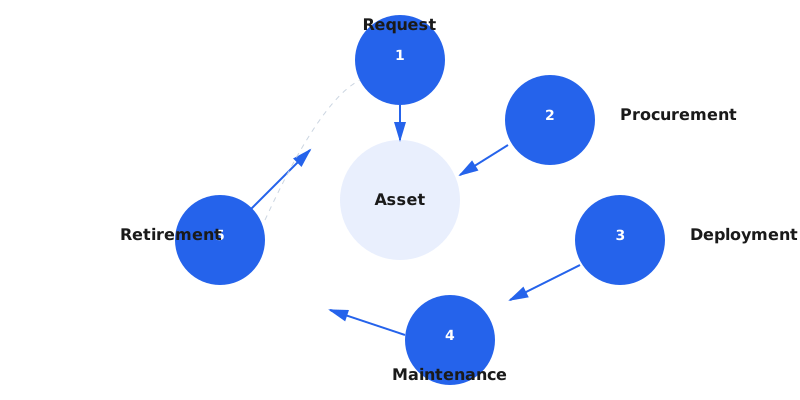
1. Request
The lifecycle begins when a user or department submits a hardware request. This stage includes needs assessment, budget approval, and specification definition. Proper request management prevents impulse purchases and ensures acquisitions align with organizational standards.
2. Procurement
Procurement transforms approved requests into actual hardware. This includes vendor selection, purchase order creation, receiving, and initial asset registration. Assets receive unique identifiers and enter the tracking system with acquisition cost, warranty details, and ownership information.
3. Deployment
Deployment covers configuration, assignment to users or locations, and activation. This stage includes imaging, software installation, security configuration, physical asset tagging, and assignment documentation. Proper deployment sets the foundation for effective tracking.
4. Maintenance
The longest lifecycle stage, maintenance includes monitoring, repairs, upgrades, moves, and warranty management. Tracking maintenance history is essential for total cost of ownership calculations and replacement timing decisions. This stage generates the most data and requires consistent processes.
5. Retirement
Retirement manages end-of-life asset disposal through secure data sanitization, de-registration from tracking systems, and environmentally responsible disposal. This stage is critical for data security and regulatory compliance. Options include resale, donation, recycling, or destruction with documented chain of custody.
Each stage requires specific processes, documentation, and controls. Organizations that excel at HAM have clearly defined procedures for every lifecycle transition, ensuring no asset falls through the cracks.
Financial Impact of Poor HAM
The cost of neglecting hardware asset management extends far beyond the obvious waste of lost devices. Organizations without structured HAM face multiple financial drains:
| Cost Category | Impact Without HAM | Annual Cost (1,000 devices) |
|---|---|---|
| Ghost Assets | 30% of assets untracked or lost | $360,000 |
| Over-Purchasing | 15% unnecessary procurement due to poor visibility | $180,000 |
| Extended Support Tickets | 50% longer resolution time without asset history | $125,000 |
| Audit Penalties | Failed compliance audits | $50,000-$500,000 |
| Missed Warranty Claims | 40% of eligible repairs paid out-of-pocket | $75,000 |
| Security Incidents | Data breaches from untracked devices | $100,000-$2,000,000 |
For a mid-sized organization with 1,000 devices, poor HAM practices conservatively cost $790,000 to $3,215,000 annually. These are not theoretical calculations—they represent documented losses from organizations that underwent HAM implementations and discovered the true cost of their previous practices.
ROI of Implementing HAM
Conversely, HAM implementation delivers measurable financial returns within the first year:
- Reduced procurement costs: 15-20% savings by identifying existing assets available for redeployment
- Lower support costs: 25% reduction through access to complete maintenance history
- Warranty optimization: 90%+ capture rate on warranty-eligible repairs
- Audit readiness: Zero compliance penalty risk with continuous tracking
- Extended asset lifespan: 20-30% longer useful life through proactive maintenance
Most organizations achieve full ROI on HAM implementation within 6-12 months, with benefits compounding annually thereafter.
HAM vs. SAM: Understanding the Difference
Hardware Asset Management (HAM) and Software Asset Management (SAM) are complementary but distinct disciplines. Understanding their differences is essential for building comprehensive IT asset management:
| Aspect | HAM | SAM |
|---|---|---|
| Focus | Physical devices and equipment | Software licenses and usage |
| Primary Assets | Laptops, servers, network gear, mobile devices | Software licenses, SaaS subscriptions, cloud services |
| Tracking Method | Physical tags, serial numbers, location scans | License keys, usage monitoring, entitlement records |
| Lifecycle | Request → Procurement → Deployment → Maintenance → Disposal | Evaluation → Purchase → Deployment → Usage → Renewal/Retirement |
| Cost Model | Capital expenditure (CapEx), one-time purchase | Operating expenditure (OpEx), recurring subscriptions |
| Compliance Risk | Data security, environmental disposal, financial reporting | License audits, usage compliance, contract violations |
| Primary Stakeholders | IT operations, procurement, facilities | Software managers, finance, legal |
While HAM and SAM serve different purposes, they intersect in important ways. Every software license requires hardware to run on, and many HAM platforms include SAM capabilities. Organizations achieve the best results when HAM and SAM teams collaborate, sharing data about device-to-license assignments and coordinating procurement decisions.
Integration Opportunity: Modern IT Asset Management (ITAM) platforms combine both HAM and SAM into unified systems, providing complete visibility into hardware, software, and the relationships between them. This integrated approach prevents scenarios like purchasing software licenses for devices that don't exist or retiring hardware that runs critical licensed applications.
Implementing HAM in Your Organization
Successful HAM implementation follows a structured approach that balances quick wins with long-term sustainability. The process typically spans 3-6 months depending on organization size and asset complexity. The hardware asset management plan guide covers each phase in depth, including the end-to-end process steps and the duplicate-record traps that derail most rollouts.
Phase 1: Assessment and Planning (Weeks 1-3)
Begin by understanding your current state:
- Asset inventory audit: Conduct a physical audit to establish baseline asset counts and locations
- Process documentation: Map existing procurement, deployment, and retirement workflows
- Stakeholder interviews: Meet with IT, finance, procurement, and department heads to understand pain points
- Compliance requirements: Identify relevant regulations and audit requirements for your industry
- Tool evaluation: Assess whether Excel-based tracking is sufficient or if dedicated HAM software is needed
Phase 2: Foundation Building (Weeks 4-8)
Establish the infrastructure and processes:
- Asset tagging system: Select and implement physical tagging methodology (barcode, QR code, or RFID)
- Tracking platform: Deploy your chosen HAM solution and configure asset categories, locations, and users
- Naming conventions: Define standardized naming for asset IDs, locations, departments, and statuses
- Process documentation: Write procedures for each lifecycle stage with clear ownership and responsibilities
- Integration setup: Connect HAM system to procurement, help desk, and financial systems where possible
Phase 3: Data Migration and Tagging (Weeks 9-16)
Populate the system with existing assets:
- Batch asset registration: Import known assets from existing spreadsheets, purchase orders, and warranty records
- Physical tagging campaign: Apply asset tags to all tracked devices with parallel data entry
- Location verification: Confirm and update asset locations through departmental walkthroughs
- Data quality review: Validate completeness and accuracy of critical fields like serial numbers and warranty dates
Phase 4: Training and Launch (Weeks 17-20)
Enable teams to use the new system:
- Administrator training: Deep-dive training for HAM system administrators and power users
- Process training: Department-specific training for procurement, IT support, and facilities teams
- User documentation: Create quick-reference guides, video tutorials, and FAQ documents
- Soft launch: Begin with a pilot department to identify issues before organization-wide rollout
- Communication campaign: Announce the new HAM system with clear benefits and expectations
Phase 5: Continuous Improvement (Ongoing)
HAM is not a one-time project but an ongoing operational discipline:
- Monthly audits: Conduct sample audits to verify data accuracy and process compliance
- Quarterly reviews: Analyze HAM metrics to identify ghost assets, over-purchasing, and process bottlenecks
- Annual reconciliation: Full physical inventory to match HAM records against actual devices
- Process refinement: Update procedures based on lessons learned and organizational changes
Success Factors: Organizations that succeed with HAM share three characteristics: executive sponsorship from finance or IT leadership, dedicated HAM administrators who own data quality, and integrated workflows that make HAM part of existing processes rather than parallel paperwork.
Excel vs. Automated HAM Solutions
One of the first decisions in HAM implementation is choosing between manual Excel-based tracking and dedicated HAM software. The right choice depends on organization size, asset complexity, and compliance requirements.
When Excel Works
Excel-based HAM is viable for organizations with:
- Fewer than 200 assets
- Single or few physical locations
- Low asset turnover (minimal new purchases or retirements)
- Simple compliance requirements
- Dedicated administrator who can maintain data quality
Excel offers zero software costs, familiar interface, and complete customization flexibility. For small teams, a well-structured Excel template can provide 80% of HAM benefits at 5% of the cost.
See the Excel HAM template guide →
When You Need Dedicated Software
Automated HAM platforms become essential when you have:
- More than 200 assets
- Multiple locations or distributed workforce
- Frequent asset movements and changes
- Integration requirements with help desk, procurement, or financial systems
- Compliance obligations requiring audit trails and automated reporting
- Multiple administrators or departments managing subsets of assets
Key Features of HAM Software
Modern HAM platforms provide capabilities impossible with spreadsheets:
- Automated discovery: Network scanning to identify connected devices without manual entry
- Workflow automation: Approval routing for requests, automatic notifications for warranty expirations
- Mobile apps: Barcode scanning and asset check-in/check-out from smartphones
- Audit trails: Complete change history showing who modified what and when
- Reporting: Pre-built compliance reports, dashboards, and cost analysis
- Integration: APIs to connect with ticketing systems, procurement platforms, and ERPs
- Access control: Role-based permissions to restrict data visibility and editing
Compare the top HAM software platforms →
Implementation Cost Comparison
| Approach | Initial Cost | Annual Cost (1,000 assets) | Administrator Time |
|---|---|---|---|
| Excel | $0 | $0 software + $15,000 labor | 10 hours/week |
| Entry-Level HAM Tool | $2,000-$5,000 | $5,000 software + $8,000 labor | 5 hours/week |
| Enterprise HAM Platform | $15,000-$50,000 | $20,000 software + $5,000 labor | 3 hours/week |
While software adds direct costs, the reduction in administrator time and improvement in data quality typically delivers positive ROI at the 200-500 asset threshold.
Getting Started Today
Hardware Asset Management delivers measurable value from day one. You don't need a perfect system to begin—start with the fundamentals and mature over time.
Your First Week Action Plan
- Day 1: Download a HAM template or sign up for a free HAM tool trial. Commit to a tracking system.
- Day 2: Define your asset categories. What types of devices will you track? (e.g., laptops, desktops, servers, network gear, mobile devices, monitors, peripherals)
- Day 3: Conduct a pilot audit in one department or location. Physically count devices and record serial numbers, models, and assigned users.
- Day 4: Enter pilot audit data into your tracking system. Focus on completeness over perfection—you can enrich data later.
- Day 5: Document one lifecycle process. Choose procurement as the starting point—define how new assets enter your system.
- Day 6: Order physical asset tags (if using). Barcode or QR code labels provide permanent tracking identifiers.
- Day 7: Present findings to IT leadership. Show asset counts, ghost asset discoveries, and the business case for full HAM implementation.
Measuring Success
Track these metrics to demonstrate HAM value:
- Asset tracking rate: Percentage of physical devices registered in HAM system (target: 95%+)
- Data completeness: Percentage of assets with all required fields populated (target: 90%+)
- Ghost asset rate: Percentage of assets with unknown location or status (target: <5%)
- Warranty capture rate: Percentage of warranty-eligible repairs filed under warranty (target: 90%+)
- Procurement savings: Dollar value of redeployed existing assets vs. new purchases
- Audit readiness: Time required to generate compliance reports (target: <1 hour)
Quick Win: The fastest path to demonstrable HAM value is warranty optimization. Export your current asset list, compare serial numbers against manufacturer warranty databases, and you'll likely discover tens of thousands in missed warranty claims. Submit those claims immediately and use the savings to fund your HAM implementation.
Next Steps
Ready to dive deeper? Explore these comprehensive guides:
HAM Lifecycle Deep Dive
Complete guide to all 5 lifecycle stages with process templates, checklists, and best practices for each phase.
Read the lifecycle guide →Request & Procurement Process
How a hardware request becomes a delivered asset: the approval workflow, the six procurement stages, and the return loop that refills stock.
Read the procurement guide →HAM Software Comparison
Unbiased comparison of leading HAM platforms including ServiceNow, Snipe-IT, Asset Panda, and open-source alternatives.
Compare HAM software →Excel Template Guide
A step-by-step blueprint for the sheets, fields, formulas, and dashboard structure that make a HAM spreadsheet work at small and mid-size scale.
Read the template guide →